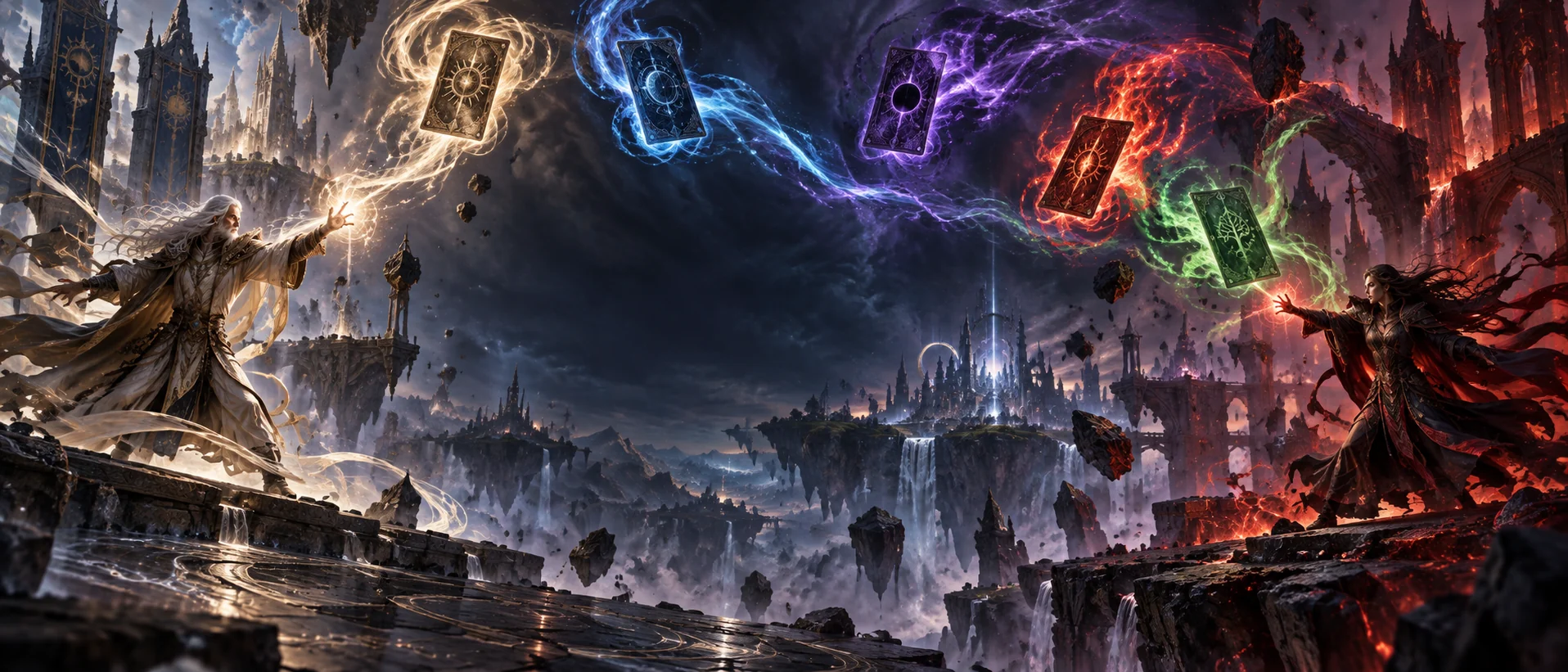
Two original fantasy spellcasters facing each other across a mystical battlefield

About Magic

A game of
endless choices.

Magic: The Gathering blends collectible cards, strategic deckbuilding, and imaginative worlds into a game that can be as casual or competitive as you want it to be.

The foundations

What is
Magic?

Magic: The Gathering is a trading card game in which each player brings a deck of spells, creatures, artifacts, and lands to the table. You play as a powerful spellcaster, using mana from lands to cast cards and outmaneuver your opponents.

Most games begin with each player drawing seven cards. You take turns playing lands, casting spells, attacking, and responding to what other players do. In a typical two-player game, the first player to reduce their opponent from 20 life to 0 wins—though some cards and formats create different paths to victory.

The depth comes from choice. Thousands of cards can be combined in countless ways, and Magic’s five colors each express a different philosophy and style of play.

Meet the five colors

Ways to play

Find your
format.

A format is a shared set of deckbuilding and gameplay rules. It determines which cards you can use, how many go in your deck, and how many people usually play.

1

Multiplayer • Casual

Commander

Build a 100-card deck around one legendary creature. Except for basic lands, every card is unique. Usually played with four people, Commander is social, expressive, and full of surprising interactions.

Deck
100 cards
Players
Usually 4
Life
40
2

Rotating • Competitive

Standard

Build a deck from recent Magic sets. Because older releases rotate out, Standard changes regularly and offers an approachable card pool for organized play and MTG Arena.

Deck
60+ cards
Players
2
Life
20
3

Open packs • Build on site

Draft & Sealed

Limited formats ask you to build from newly opened booster packs instead of bringing a finished deck. Draft rewards card evaluation and adaptability; Sealed is a relaxed way to experience a new set.

Deck
40+ cards
Players
2 per match
Life
20
4

Nonrotating • Constructed

Modern & Pioneer

These competitive formats use larger pools of cards that do not rotate. Pioneer reaches back to 2012; Modern reaches further, creating distinct strategies and powerful long-term decks.

Deck
60+ cards
Players
2
Life
20

Your guide through the game

What Mulligan Mage
can help you do.

You do not need to learn every card or rule before you begin. Mulligan Mage organizes the essentials into clear paths so you can move from curiosity to your first confident game.

1

Start with confidence

Compare MTG Arena and tabletop play, learn the basic flow of a turn, and choose the easiest first step for you.

Getting started
2

Find your play style

Explore the values, strengths, and signature strategies of white, blue, black, red, and green.

Explore the colors
3

Build a better deck

Use practical card ratios and the Commander deck architect to turn an idea, budget, and power goal into a playable plan.

Build a deck
4

Join the community

Understand the social side of Magic and find ways to connect with local stores, events, and other players.

Find your table

Ready when you are

Every great deck
starts with one card.

Choose the path that matches where you are today. The rest of the game will unfold one turn at a time.

Start learning